Your Cart is Empty


You've been there. You're looking at a dry shampoo powder, you actually want to try it, and then you put it back. Because the last time you used something similar, your roots looked like you'd dusted them with baking flour.
It's a real concern, especially with natural formulas that use white powders like arrowroot and clay. And it's kept a lot of dark-haired people away from dry shampoo powder entirely — which is a shame, because they work better than most aerosols once you know how to use them.
Here's what we've actually found: the white cast problem is almost entirely about technique. It's not about finding a formula made for dark hair. It's about how you apply it. That's the honest answer, and it's one the dry shampoo industry doesn't talk about much.
The Yellow Bird's dry shampoo formula was developed with all hair colors in mind. We include ingredients that help with blending, but we'll tell you upfront: the technique you use matters more than the color of the powder.
At a Glance
White cast happens when dry shampoo particles coat the surface of the hair strand without fully blending in. The powder absorbs oil from your scalp, but if it isn't worked in, it sits on top of the hair and reflects light — which shows up as visible white or grey on dark strands.
The science behind it comes down to particle size. Research on dry shampoo formulation shows that particles in the 10-50 micron range provide strong oil absorption but can remain visible on hair if not blended in properly. Finer, more finely milled particles distribute more evenly and are far less likely to show. That's why a well-formulated powder with a fine grind behaves very differently from a coarser one, even when both are technically "white powder."
Dark hair amplifies the problem for obvious reasons. White particles stand out more against dark strands than against blonde or light brown ones. But the cause is always the same: unblended residue. Fix the technique, and the color of your hair stops mattering.
Understanding how your scalp produces oil helps here too. Dry shampoo is absorbing sebum at the roots, not cleaning the hair shaft. The powder only needs to reach the scalp and be worked in from there — and that's exactly where most people skip a step.
No. In the natural dry shampoo category, the distinction between a light hair formula and a dark hair formula is mostly a marketing label that doesn't reflect a meaningful performance difference.
We tested different formulations at The Yellow Bird, including versions with and without additional color-blending ingredients. The difference in visible cast was minimal. What made the biggest difference every time was how the product was applied. A white powder formula worked in thoroughly and applied in a small amount performs the same as a tinted version on dark hair. A tinted formula applied sloppily still leaves residue.
Research on dry shampoo absorption backs this up: the way powder interacts with the hair surface depends primarily on particle distribution and whether it's worked into the scalp. Pigment additions can soften the visual impact slightly, but they don't replace technique. For natural formulas especially, where you're working with gentle absorbents rather than alcohol-based aerosol carriers, how you apply the product matters far more than what color it is.
We include ingredients that help the formula blend smoothly, because they do make a small difference. But we're not going to tell you that you need a special dark hair formula to avoid white cast. In most cases, you just need to apply it correctly.
| What the Marketing Says | What Actually Works | |
|---|---|---|
| Formula color | You need a tinted dark hair formula | Particle fineness matters more than color |
| Application amount | Apply generously for best results | Less is more; add a second pump if needed |
| Technique | Spray and go | Wait 30-60 seconds, then massage in thoroughly |
| Visible residue | Caused by using the wrong formula | Almost always caused by skipping the brush-out |
| Format | Aerosol distributes more evenly | Powder gives you more control over placement |
The technique is straightforward, but most people rush at least one step. These four habits make the difference between visible residue and hair that looks naturally refreshed.
Apply a small amount at the roots only. Sebum comes from your scalp, not your ends. Applying powder along the full length of your hair puts product where it doesn't need to go and adds unnecessary residue. Start with one or two pumps directly at the roots, section by section.
Wait before working it in. Give the powder 30 to 60 seconds to absorb oil before touching it. This is the step most people skip. When you rub it in immediately, you're moving around a powder that hasn't attached to oil yet — it just coats the strand. Wait, and it absorbs first. Then it blends.
Massage it in thoroughly. Use your fingertips to work the product from the scalp outward, then follow with a brush. This is the most important step. The right technique lifts most of the residue away from the hair surface and distributes what remains so evenly it becomes invisible. Customers with dark hair consistently say this step is what makes it work.
Apply before bed when you can. By morning, the powder has had hours to absorb. There's nothing left to show. This is especially useful if you're new to dry shampoo powder and still finding your amount.
At a Glance
The most useful feedback on this question comes from people who were skeptical first.
One customer with dark brown hair put it simply: the formula "never shows in my hair." Another said it "works so well even with dark hair — just make sure to rub it in well." That phrase keeps coming up independently from different reviewers. The technique, specifically the rub-in step, is what they land on.
Another customer said: "I've tried a few different dry shampoos over the years and they always leave a faint white tint to my light brown hair. This one does not."
It's worth including the honest one too. One reviewer noted that the formula "will make your hair look lighter/blonder/grayer" and added: "But I don't mind the look." This is real feedback, and it reflects what happens when you apply too much without working it in fully. The solution isn't a different product — it's a lighter hand and a thorough massage-in.
One reviewer's title said everything: "Love this stuff! Even for dark hair!!" The exclamation points suggest she didn't expect it to work. That pattern — skepticism followed by surprise — shows up across the reviews consistently. People who were nervous about switching from aerosol found that the formula performed better than expected, on dark hair included.
For dark hair specifically, a well-formulated natural powder gives you more control than aerosol, which is the main thing that helps avoid visible cast.
Aerosol dry shampoos suspend fine particles in a propellant that evaporates on contact. The delivery is fast, but you don't control where the particles land or how densely they coat each strand. On dark hair, patches of concentrated residue are harder to spot during application but very visible afterward. With a pump powder, you see exactly where the product goes and can work each section before moving to the next.
Research comparing dry shampoo powder and aerosol formats consistently points to one aerosol advantage: speed. It's faster for beginners. But for anyone who has dealt with white cast before, the slower, more intentional pump-and-massage approach of a dry shampoo powder is actually the more reliable method on dark hair.
There's also the ingredient side. Most conventional aerosol formulas use propellants like butane and isobutane, plus alcohol as a carrier — none of which are gentle on the scalp over time. Our complete guide to natural dry shampoo covers the full comparison if you want the deeper breakdown. The short version: dry shampoo powder is the better option for regular use, regardless of hair color.
At a Glance

Dry shampoo powder works on dark hair. The white cast problem that keeps people away from it is real, but it's almost always a technique problem, not a formula problem. Apply a small amount, wait for it to absorb, and work it in thoroughly — and visible residue goes away, regardless of your hair color.
The dark hair formula category is worth being honest about: it's mostly marketing. A well-made natural dry shampoo powder with fine particles performs the same on dark hair as a tinted version when applied correctly. What you're really looking for is a formula with quality ingredients, a fine grind, and no aerosol propellants doing the heavy lifting.
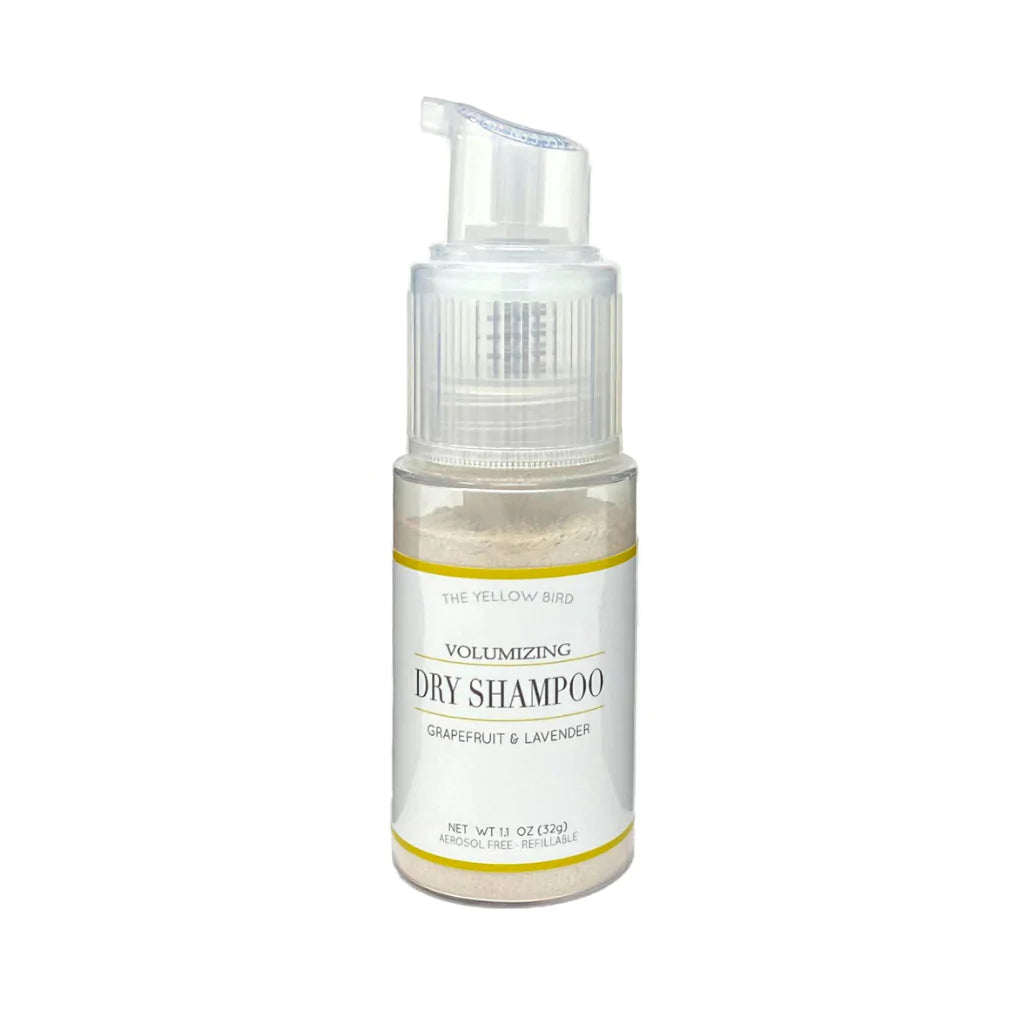
The Yellow Bird Grapefruit Lavender Dry Shampoo was made for all hair colors. It uses organic arrowroot and kaolin clay as the absorbents, with no talc, no aerosol, and no synthetic fragrance. It's refillable, made in small batches in North Carolina, and it works the same on dark hair as on light — as long as you give it the thirty seconds it needs to absorb. We think honest products and honest information are a better approach than selling a "brunette formula" that does the same thing as every other natural dry shampoo powder on the shelf.
For more on stretching your washes and building a dry shampoo routine that actually works, our post on stretching your hair between washes is a good next read.
It can if it isn't worked in, but it doesn't have to. White cast comes from unblended powder sitting on the hair surface. Apply a small amount at the roots, wait 30-60 seconds, then massage in thoroughly with your fingers and follow with a brush. Done correctly, a finely milled natural dry shampoo powder is virtually invisible on dark hair.
Not in the natural dry shampoo category. The difference between light hair and dark hair formulas is mostly a marketing distinction. The real variables are particle fineness and application technique — both of which apply to any well-made dry shampoo powder. A white powder worked in correctly disappears on dark hair just as effectively as a tinted version.
Apply a small amount directly at the roots, section by section. Let it sit for 30-60 seconds so it can absorb oil before you touch it. Then massage it in firmly with your fingertips and follow with a brush. Applying before bed is another reliable approach because the powder has hours to absorb fully before you need it to look invisible.
Yes. The formula contains no harsh chemicals that would strip or affect hair color. Organic arrowroot and kaolin clay are gentle mineral-based absorbents. Many customers with color-treated hair use it regularly without any impact on their color.
A heavy application that isn't worked in fully can leave some lightening at the roots. If that happens, it means either too much product was applied or the massage-in step was rushed. Start with one or two pumps, work it in thoroughly, and add more only if needed. Less product applied well always outperforms more product applied quickly.
By The Yellow Bird
The Yellow Bird is a family-owned natural skincare and wellness brand handcrafting plant-based products in North Carolina since 2015. Every formula is made with simple, honest ingredients and no synthetic fragrances, parabens, or sulfates.